Engineering Design Project · 2026

Single-Hand Container Opener

A user-centered engineering design project rethinking how people with limited hand mobility open everyday containers — independently, comfortably, and with one hand.

By Justin Chiu · Tyler Compton · Carlos Alfaro
01 — Introduction

Introduction & Problem Statement

The Problem Space

People who have had an amputation in their upper limbs and those with conditions that affect their ability to grip (including arthritis, stroke recovery and repetitive strain injuries) struggle to open everyday containers without assistance. Standard containers are designed to be used by two hands, one to hold the container and the other to twist, pull, or pry open the lid.

Existing assistive tools each solve a portion of the problem but are lacking. Electric openers are costly, need tabletop space and are not compatible with all lids. Under-cabinet openers are permanently installed and are designed to work with jars. Rubber grip pads still need an extra hand to hold on.

Who Is Affected

Our primary users are people with one arm or hand (congenital or acquired), people recovering from upper-limb injuries, and older adults experiencing age-related grip decline.
Problem Statement
"People with one arm or weak grip strength often struggle to open everyday containers like jars, bottles, and cans, as they require both hands and a strong grip. They need a simple but effective way that will help them easily and independently open these containers."
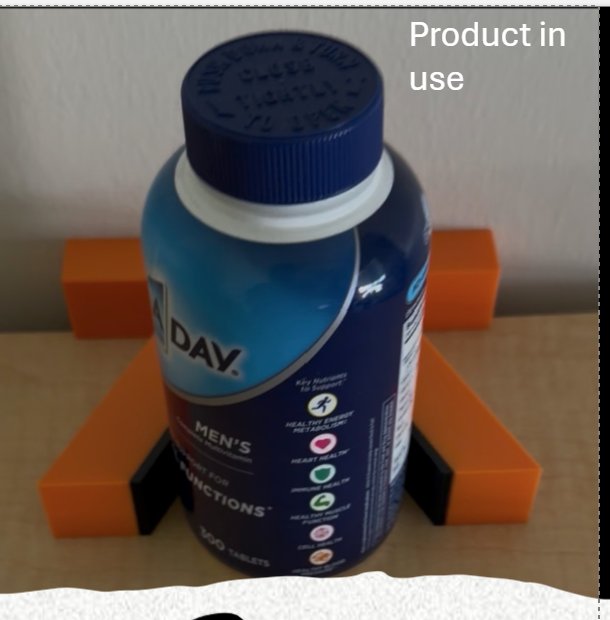
Final product in use holding a vitamin bottle
The final device holding a vitamin bottle steady for one-handed opening.
02 — Discovery

Stakeholder Research

Research Methods

Our team conducted stakeholder research through direct observation of the target use case, review of existing assistive-technology literature, and structured analysis of user needs.

Key Findings

  • Containers slide: without a second hand to anchor the container, it moves across the countertop when force is applied to the lid, making it impossible to generate sufficient torque.
  • Two actions required simultaneously: almost every lid type requires holding + twisting at the same moment.
  • Existing solutions are too specialized: most products target a single container type and do not generalize.
  • Users prioritize independence and dignity: needing to ask for help with a basic kitchen task is demoralizing.

Stakeholder Priorities

Safetyno sharp edges, no tipping hazard
Ease of useminimal setup, intuitive placement
Reliabilityworks consistently across container sizes
Independenceusable entirely without help

Ethical Considerations

We decided not to create a "powered device" solution. The design is intended to be unobtrusive and not stand out as a sign of the user's handicap. We focused on materials and manufacturing processes that would ensure the finished product would be cost effective.

We recognize that our team does not consist of those who have lived experience with a ULD. Future research will need to be done in collaboration with the user community.

03 — Divergence

Ideation & Concept Development

Brainstorming Process

We began with an unconstrained brainstorming session using sticky notes, generating as many ideas as possible before applying any filters. Ideas ranged from motorized mechanisms to purely friction-based passive holders.
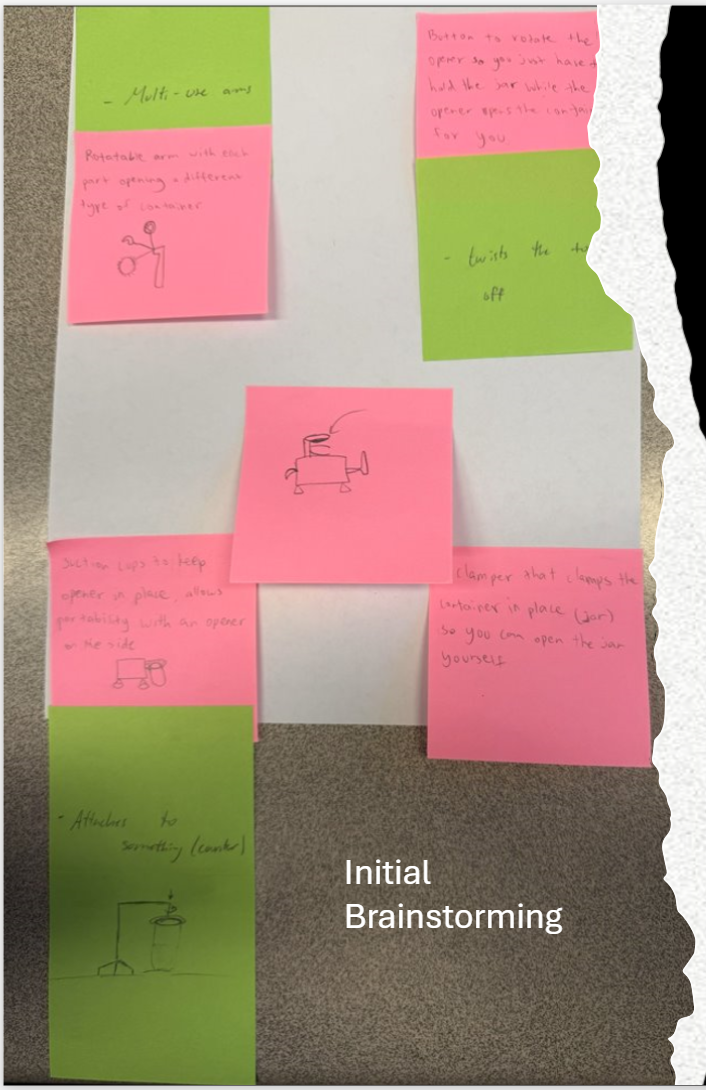
Initial brainstorming sticky notes
Initial brainstorming session.

Concepts Considered

Concept 1 — Motorized Rotating Opener

A powered device that clamps onto a lid and rotates it via a motor. Pros: zero grip strength. Cons: expensive, batteries, bulky, size-specific.

poweredsize-specific
Concept 2 — Suction-Cup Base with Side Opener

A suction pad anchors the container while a side lever opens it. Pros: good stability. Cons: complex, only works on flat-bottomed containers, fails on textured surfaces.

suctionmulti-part
Concept 3 — V-Shaped Passive Holder (Selected)

A fixed V-channel that grips the container between two angled walls. The friction replaces the stabilizing hand, freeing the user's single hand to apply torque. Pros: no moving parts, universal sizing, cheap. Cons: relies on counter mounting.

passiveuniversallow cost

Concept Selection Criteria

  • Supports one-handed operation without any setup adjustment per use
  • Accommodates multiple container diameters without swapping parts
  • Reduces required grip strength via geometry rather than power
  • Stable enough to withstand the twisting force applied to a stubborn lid
  • Simple and inexpensive to manufacture (target: <$5 in materials)

Why We Chose Concept 3

The V-shaped passive holder scored highest on every criterion. The wedge geometry is self-adapting: a wider container simply contacts the walls higher up, while a narrower container seats deeper into the V. The absence of moving parts means nothing can break or jam, and the core geometry can be 3D printed in a single piece.

ConceptStabilityForceAccessibilityTotal
Lever Clamp 3/54/53/510/15
Countertop Cradle ✓ selected5/54/55/514/15
Geared Crank 4/55/53/512/15
04 — Make

Prototyping & Iteration

Iteration 1
Small Prototype

Modeled in CAD with a channel width of approximately 4.47 inches and 3D printed to validate the V-geometry. The principle worked for small containers but the narrow channel could not accommodate larger-diameter containers, revealing size range as our primary design gap.
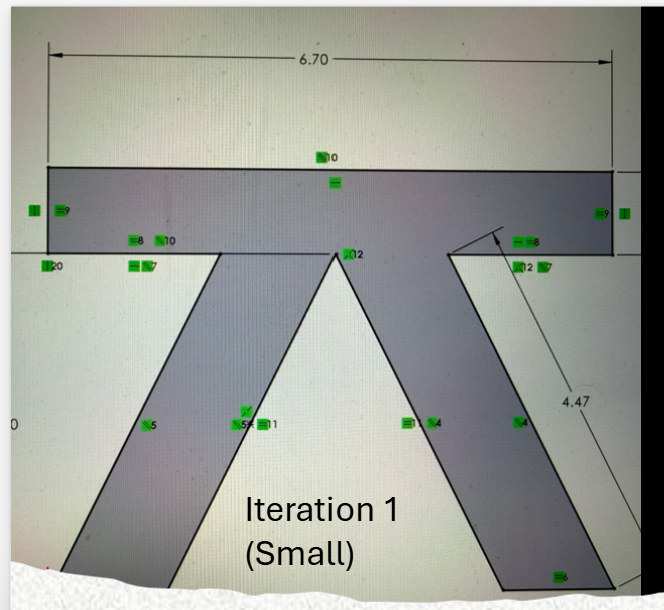
Small Prototype
Iteration 2
Medium / Large Prototype

Expanded the channel to approximately 6.75 inches and refined the wall angle to optimize the friction-to-force ratio. This version held a wider range of containers. Testing also showed a bottom friction layer was unnecessary — command strips provided ample mounting force.
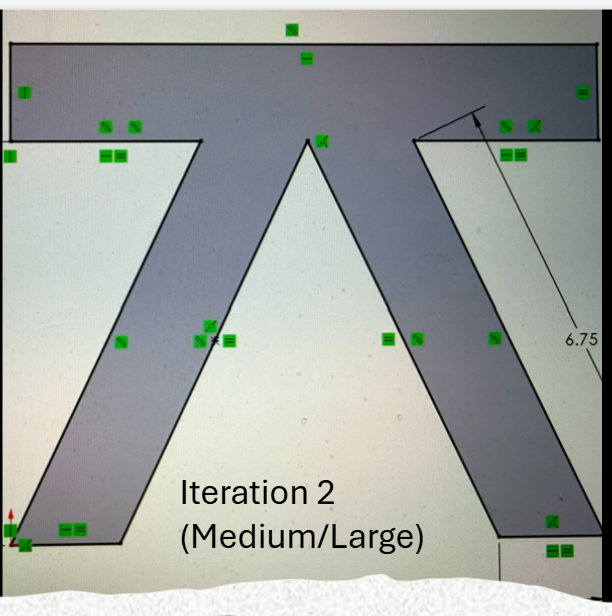
Medium / Large Prototype
Final
Final Prototype

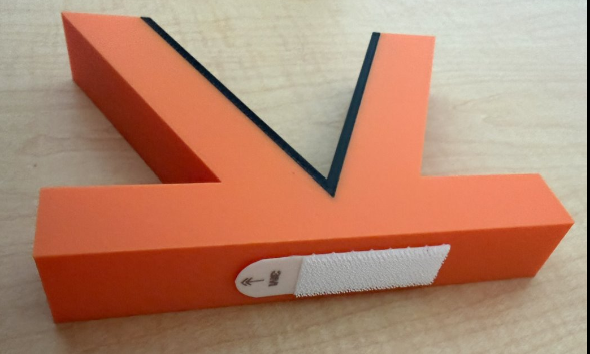
A single-piece 3D-printed V-shaped holder with rubber friction strips lining the inner channel walls, mounted with command strips. The geometry self-centers containers; the rubber lining increases friction; symmetrical design allows both opening and closing; grip height is adjustable by repositioning the command strips.
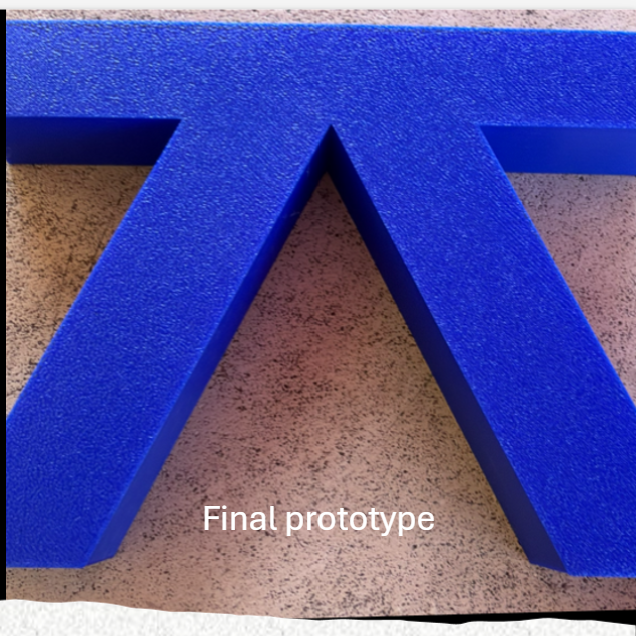
Final Prototype

Manufacturing

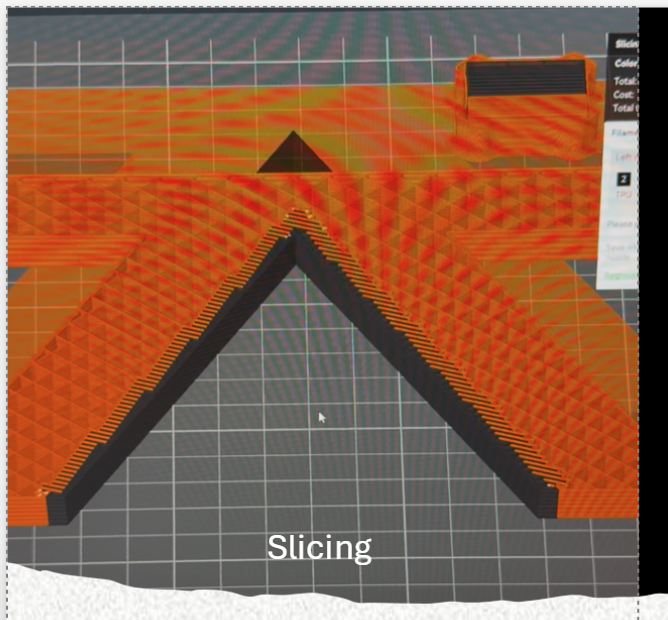
3D printer slicing preview of the V-holder
Slicing preview prior to 3D printing.

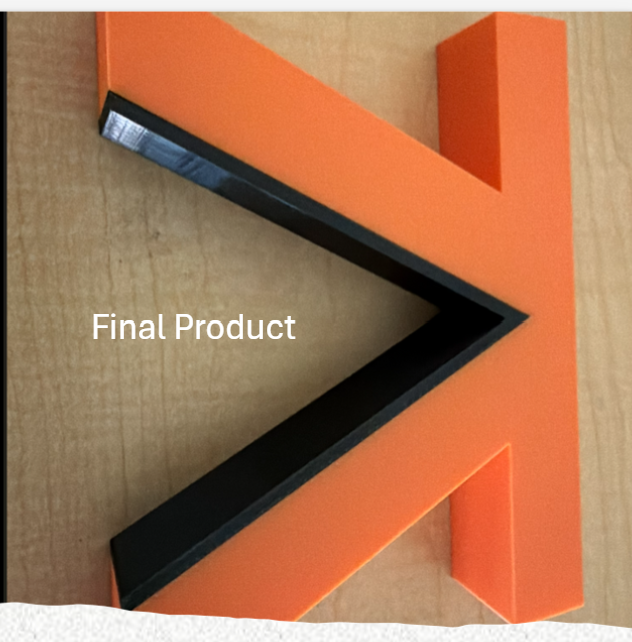
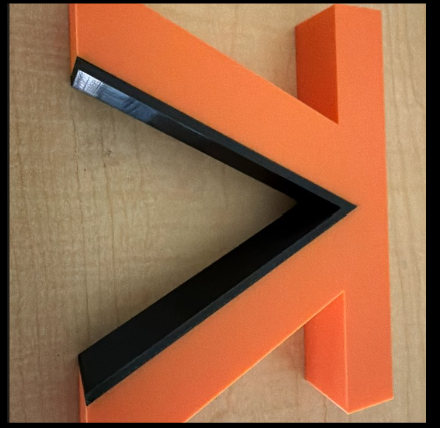
Final Product

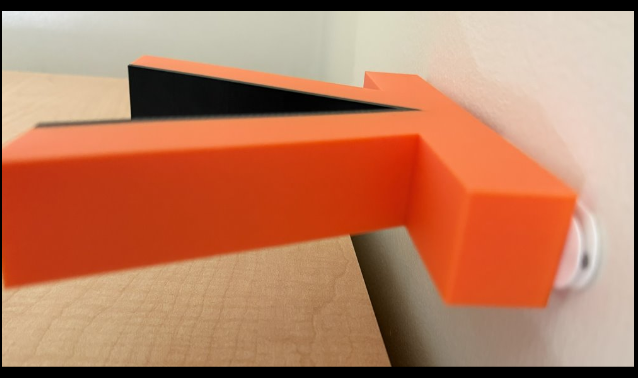
Final product top view
Final product angled view
Final product showing rubber friction strip
Final product mounted with container in channel

Testing & Findings

  • Single-hand operation: fully achievable across all tested container sizes
  • Setup: one-time; no adjustment between uses
  • Stability: command-strip mounting held firmly under twisting force
  • Material cost: 3D-printed plastic + rubber strip + command strips kept unit cost minimal

Remaining Tradeoffs

  • Requires a flat, stable mounting surface (counter or table)
  • Command strips may leave adhesive residue on some surfaces
  • Extremely small containers may not seat fully in the V-channel
05 — Looking back

Individual Reflections

Carlos Alfaro
During this project, I mostly learned about the necessity to design with the actual end product in mind. That may sound obvious, but it can be really easy to get carried away during the design process and design something completely impractical and not easy to manufacture, let alone the feasibility and stability of the design. I speak from experience when I say that it is hard to visualize that end product when designing, making sure you're applying end product necessities to the initial designs. I think as a unit, we collaborated really well. We handled conflict well. The most "conflict" we had presented was the inevitable scheduling issues or distribution of responsibilities. Other than that, people understood their roles well and played accordingly. I think we struggled a lot with the ideation of the design of the product. Our concept ideas were kind of all over the place and some of them were really out of the box. We decided to prioritize simplicity and practicality for the design, and that is how we came upon our final design choice. We came upon the struggle of not knowing in what direction to take our design, and we overcame it by focusing on the aspect of design we wanted to prioritize most in our product.
Justin Chiu
This course was the first course that taught me how designing works. I learned that designing isn't just thinking of an idea and acting on it, but that there are many elements that are taken into account when thinking of a design, such as cost, efficiency, simplicity in manufacturing, and many more. Before the final design is created, there is a lot of thought and work that needs to be put into arriving there. These include researching products that already exist that do the things we want, brainstorming about many designs, comparing them to each other, and then prototyping to see if the design actually works and does what we intend it to do. A conflict that we had was that we were assembling our prototypes and testing them at the last minute, which made the whole process feel really rushed. This changed how we worked as a team, as we started scheduling meetings outside of class ahead of the deadlines to get what we needed done. Collaboration and roles were mostly managed along the way. If there was work needed to be done, group members who had the time would get things done. Communication was mostly done by texting, whether it was for scheduling meetings or reminding group members what assignments we needed done. Something I would do differently is to schedule more meetings outside of class to work on designing, which would allow us to potentially come up with even better designs for our project problem that we were addressing. A time where I thought I didn't know what to do was when we didn't have our prototype ready for our in-class presentation. Because of the circumstances, 3-D printers were in high demand, and we couldn't get access to it until the day of the presentation. I didn't know how we were going to get our prototype and slideshow done before class time. What we did was make a detailed plan outlining what needed to be done that day to be ready for the in-class presentation of our prototype. We planned to work on the actual slideshow we were presenting while waiting on our prototype to 3D print, and then testing it after it was done and updating our slideshow with new, relevant information. Some advice I would give to a future design team is to step up when needed, whether it be taking leadership, organizing tasks, making decisions, or helping teammates. A design team shouldn't fall behind on deadlines because once they stack, it'll be too overwhelming and seem too much to do all at once.
Tyler Compton
A really big insight that I gained from the design is how something small and not over the top can do many things and be helpful to many people. I think a turning point was the fact that we wanted something that was easy to manufacture and all of our ideas at the beginning were not easy and we had to start over and think. We just messaged and all came to an understanding of who would do what and what sacrifices we had to make and shifting workloads based on who had what during the week. I would change the aesthetic design of the part to not make it so blocky and have a little more finesse on it, besides that nothing. I would say the best advice is to all communicate together because one person with a good idea and no one understanding it is worse than a bad idea with everyone understanding it. One time that I said I don't know was when we didn't know what design we wanted to come up with we had idea after idea and the way we solved it was to look around and go back to basics and just observe our surroundings.
06 — Reference

Appendices

A
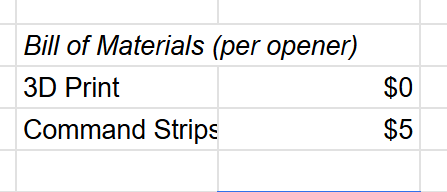
Appendix ABill of Materials (BoM)
Bill of Materials: 3D Print $0, Command Strips $5
B
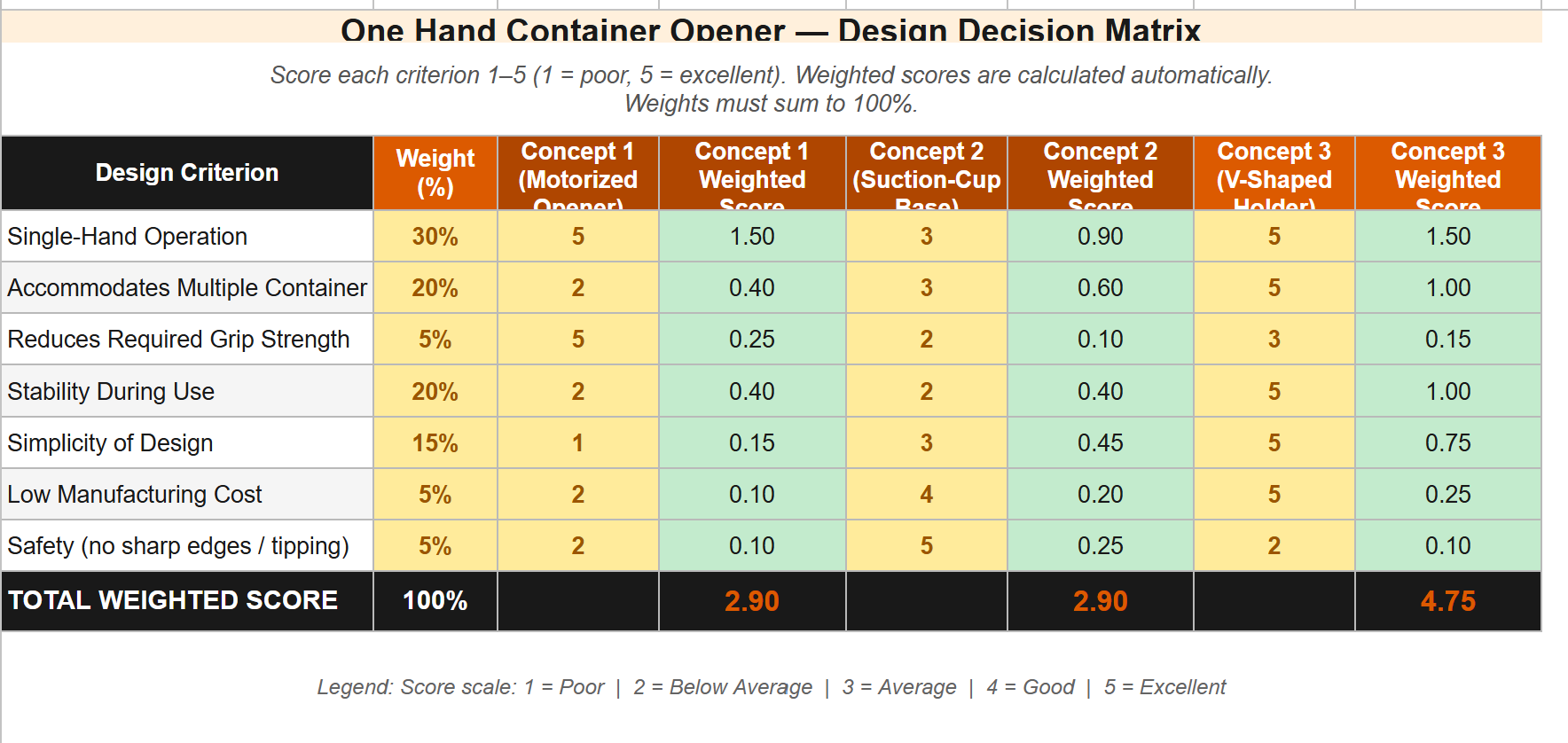
Appendix BDesign Decision Matrix
Weighted decision matrix comparing Motorized Opener, Suction-Cup Base, and V-Shaped Holder concepts. V-Shaped Holder scores 4.75 total.
C
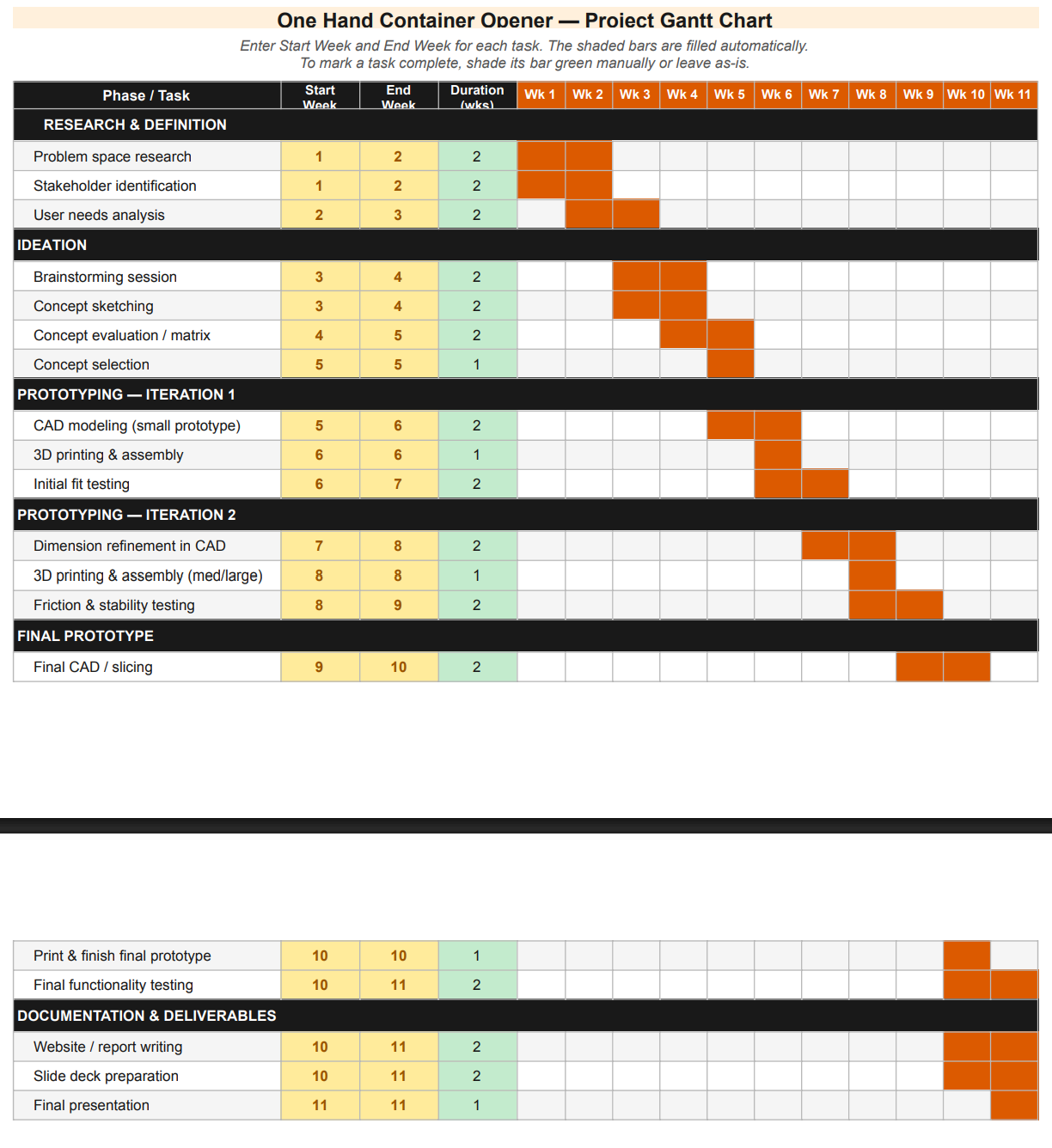
Appendix CProject Gantt Chart
11-week Gantt chart covering Research, Ideation, Prototyping iterations 1 and 2, Final Prototype, and Documentation phases.
D
Appendix DFree-Body Diagram (FBD)
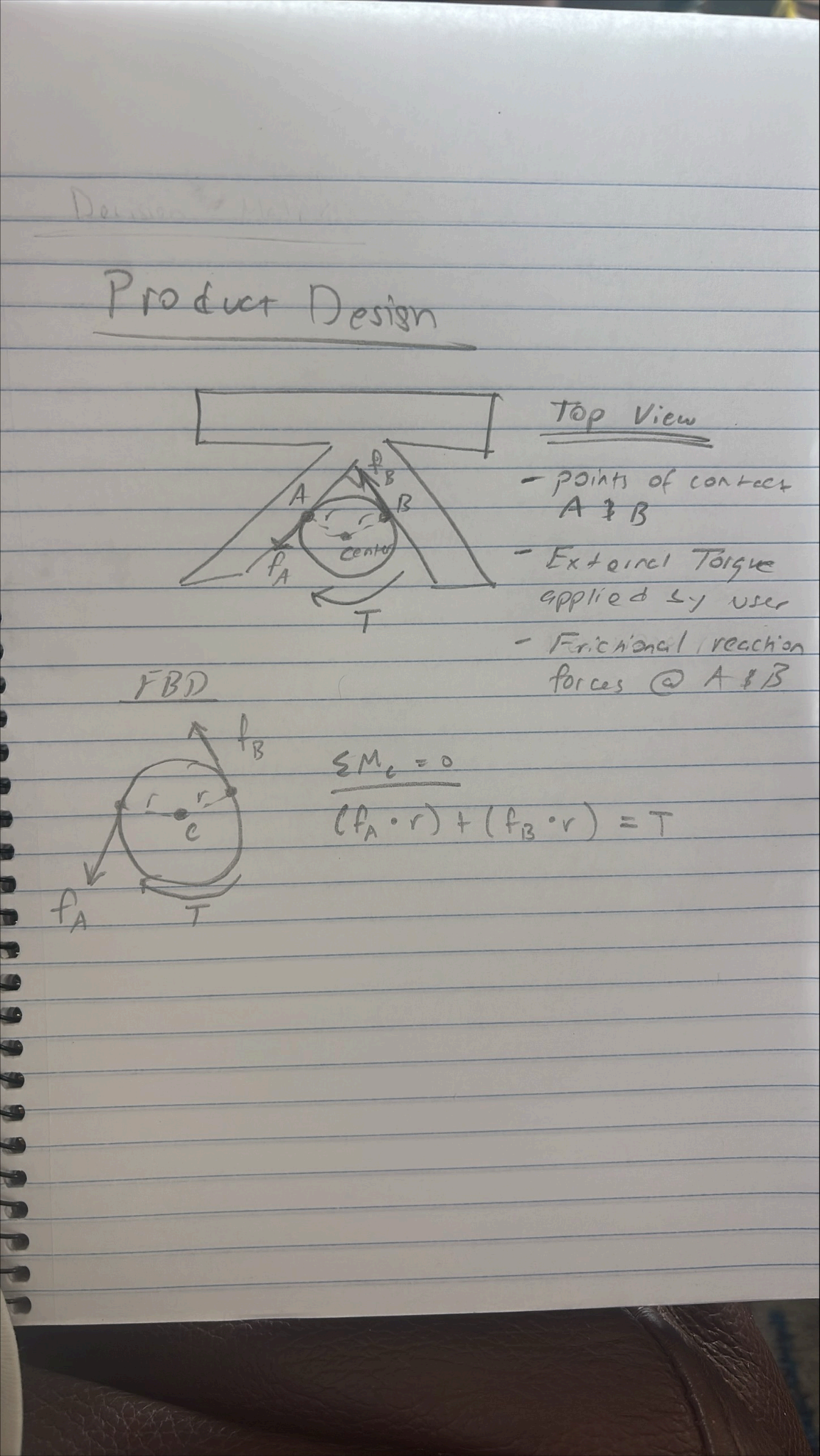
Hand-drawn FBD showing top view of V-holder with container, contact points A and B, frictional reaction forces, and applied torque T. Equation: (f_A · r) + (f_B · r) = T.